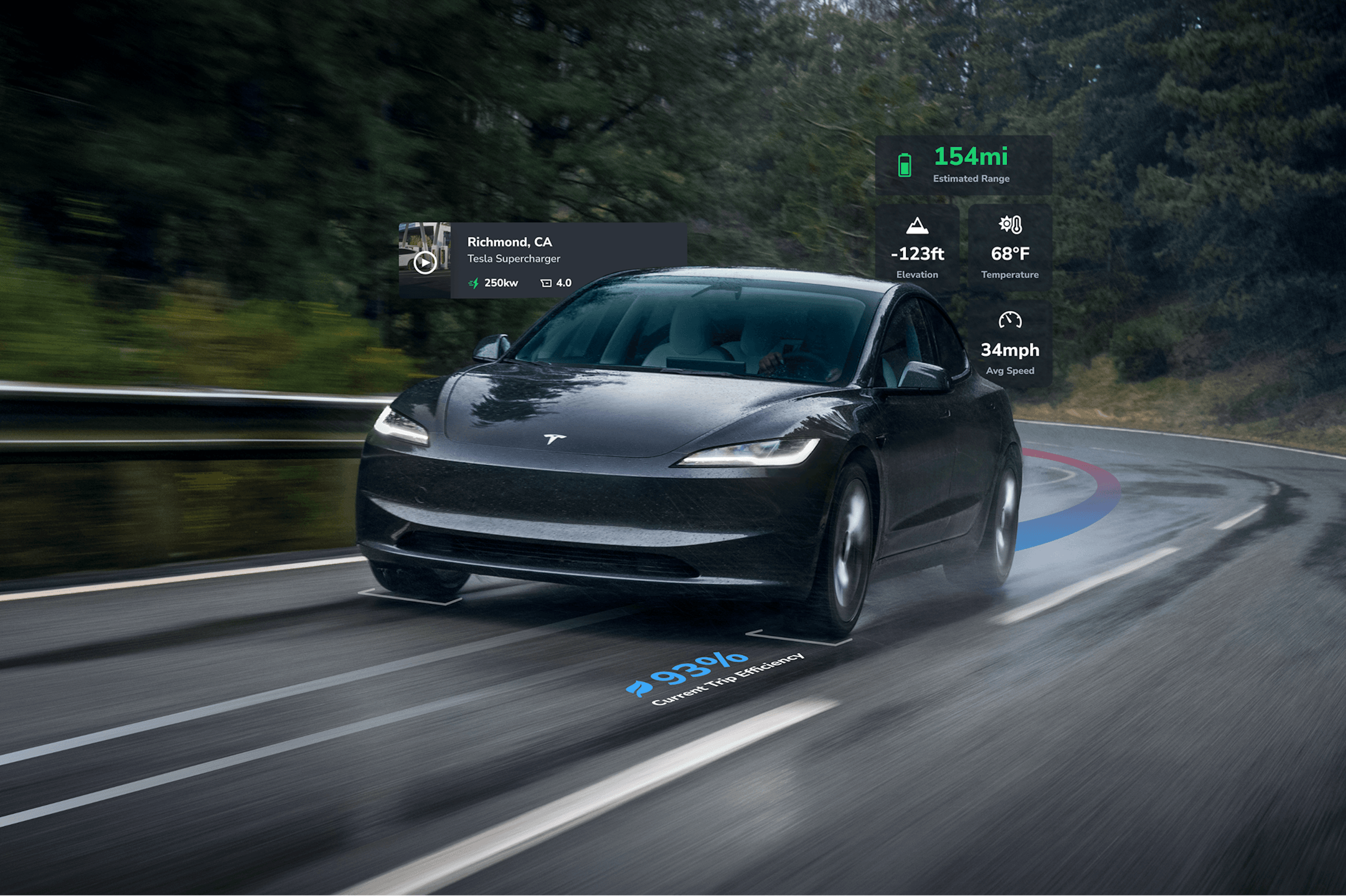
Tesla vehicles are essentially computers on wheels. Every trip, every charge cycle, every battery fluctuation generates a continuous stream of data. Tesla benefits from that data, but the owner, for the most part, doesn't get to see any of it.
In the early days of the EV market, that gap mattered more than it might seem. People have had decades to understand how internal combustion vehicles work and what to expect from them. But EVs were new, and even the most casual owners had a deep curiosity about how their vehicle was performing, how charging actually affected the battery, and what their real-world range looked like. TezLab was there to answer those questions with data.
The result: the #1 rated companion app for Tesla owners worldwide, with hundreds of millions of miles tracked, coverage across 99% of all Supercharger locations on the planet, and an expanding platform that now supports Rivian vehicles as well.
The Challenge
The native Tesla ownership experience had real gaps. No long-term trip history, no way to monitor phantom drain — the range a vehicle loses while parked due to always-on systems like sentry mode and temperature management — no benchmarking against other owners, and no access to the raw telemetry the vehicle was already generating. The enthusiast community wanted more, and all the data they needed was already there.
Surfacing that data was a challenge in itself. But the product questions ran just as deep. A new user has no trip history, no charge data, nothing to look at. The whole value proposition is invisible until they start driving. The team needed to figure out how to make the app useful from the moment someone opened it, how to present dense telemetry without overwhelming people, and how to build something that could start with power users and eventually reach a much wider audience.
The Solution
Turning Data Into Something You Can Actually Use
TezLab had a strong concept. Turning it into a consumer mobile app that worked for real people required a different kind of partner.
Tesla generates an enormous amount of telemetry per drive, but on its own it doesn't tell the full story. The team layered in data from external APIs, including elevation changes and the carbon impact of charging sessions, to give users a more complete picture of their driving and environmental footprint. The challenge was making all of that legible without making it feel like homework. Drive reports were built around a large, prominent map with a color-coded efficiency line overlaid on the route, giving users an immediate read on how their trip performed. A tabbed interface beneath the map let users explore specific data dimensions without getting lost. Drop a point anywhere on the route and the app shows exactly how the car was performing at that moment, tying abstract numbers to real roads and real decisions.
The same thinking went into charge and usage reports, including tax export functionality for users who needed to document vehicle usage for business purposes.
Range anxiety is one of the biggest friction points in EV adoption. The team addressed it with a charging map featuring range rings that showed exactly how far a driver could go on their current charge. It removed the guesswork from trip planning and gave new users something immediately valuable before they'd generated a single mile of data.
Designing for Day One
That last point opened up one of the harder design problems on the project: what does a new user actually do?
A new user downloads TezLab and opens it for the first time. There's no trip history, no charge data, no efficiency metrics. The whole value proposition is invisible. The team iterated on onboarding across multiple rounds, building engagement pathways that didn't depend on accumulated data. The charging map worked from day one. So did a community feed and car photo uploads. New users had something meaningful to do before they'd taken their first tracked drive, which gave them a reason to come back until the data started building up.
As the product matured, community features layered on top of that foundation: groups, a social feed, car photo sharing, gamified driving milestone badges. TezLab's appeal expanded well beyond the hardcore enthusiast. Tezlab was also able to ship a full suite of vehicle controls and a WatchOS app, putting locking, climate, and charging status directly on the wrist.
Building for Consistency at Scale
A product that spans iOS, Android, web, and WatchOS can fragment fast. The team took a design system-first approach, building shared components that kept the experience consistent across every platform. The premium feel wasn't something applied at the end. It was baked into the architecture from the start, which mattered for a product that needed to feel as polished as the vehicles it supported.
The design team also overhauled the color system to support a new light mode, migrating from static styles to a variables-based architecture that mapped every token across both themes.
On the infrastructure side, HappyFunCorp chose React Native to deliver high performance across iOS and Android from a single codebase, and engineered a tracking system resilient enough to keep working when drivers lose cellular service in remote areas. The backend integrates directly with vehicle APIs to process massive, continuous streams of telemetry data.
As the user base scaled, the team migrated the entire platform from Heroku to Kubernetes, implementing self-healing systems, configuring networking policies to preserve real user IP addresses, and using resource constraints to make sure the most demanding tasks always had the compute they needed without affecting app performance elsewhere.
The Results
TezLab is the #1 rated Tesla companion app in the world. Users have tracked hundreds of millions of miles across 99% of all Supercharger locations on the planet. The platform now supports Rivian in addition to Tesla, with more EV brands on the roadmap.
What started as a data tracking tool for enthusiasts is now the defining companion app for EV ownership, built on a product foundation that was designed to grow from the beginning.