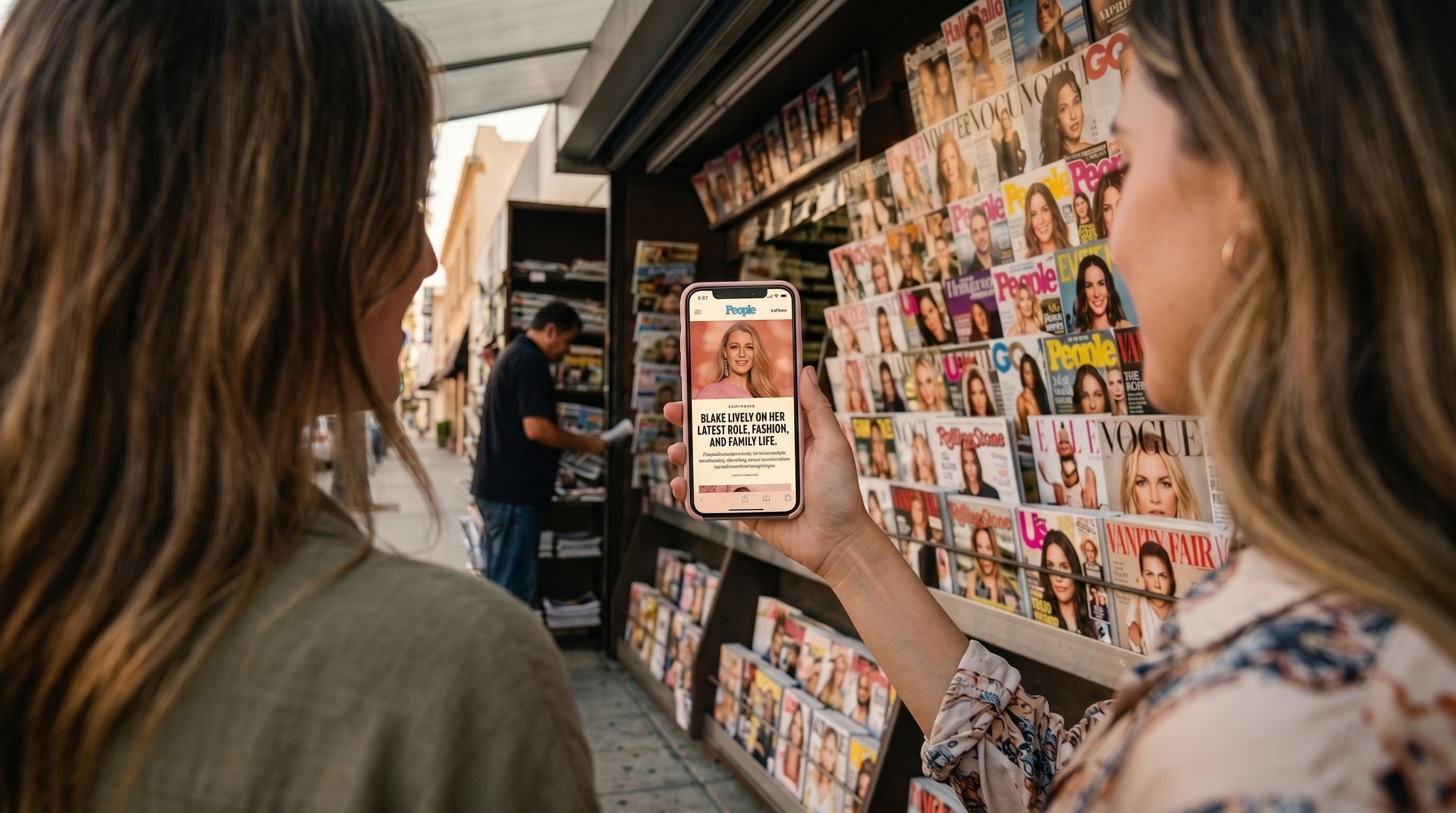
People Inc. is the largest digital and print publisher in the United States. The company owns more than 40 brands, including People, Food & Wine, Travel + Leisure, Allrecipes, Better Homes & Gardens, Entertainment Weekly, and Southern Living. More than 175 million people visit its properties every month, and the People website alone draws over 10 million visitors a day.
That's the kind of audience most companies spend a decade trying to build. People Inc. already had it. What they didn't have was the production infrastructure to make any of it feel personal at the individual user level.
The challenge
People Inc. wanted a personalization engine for the People magazine app: a feed that learned what each user cared about and adapted accordingly. A Taylor Swift superfan, a breaking-celebrity-news addict, and an Allrecipes weeknight cook should each see a different version of the same product, and the algorithm should know the difference.
The vision was clear and the talent was already in-house. People Inc. had a data science team staffed with PhDs and engineers from places like Microsoft, with deep expertise in language models and predictive analytics. Their strength was research and modeling. The piece that hadn't been built yet was the production system to bring any of it to life.
People Inc. needed a partner who could build scalable infrastructure to support the AI/ML models, connect a React Native mobile app to a Vertex AI integration in Google Cloud Platform (GCP), and get a product out the door against a real launch deadline.
They brought in HappyFunCorp.
The approach
Two services, one architecture
HappyFunCorp built two TypeScript and Node services that formed the backbone of the personalization platform. The split between them was deliberate, and it mirrored the actual flow of information through the system: user behavior writes in, personalized content reads out.
The Signal Service handled the write path. Every time a user interacted with the People app, the Signal Service captured that engagement data in real time, writing to Firestore and Redis. From there, the data flowed downstream into the client's Vertex AI integration in GCP, where the data science team used it to train and refine their personalization models.
The Feed Service handled the read path. It pulled from Firestore, Redis, and the data science layer to assemble a personalized content experience for each user, balancing editorial priorities like breaking news against algorithmically driven recommendations. Because each service was independent, each could be tuned and scaled on its own as traffic patterns evolved.
Where editorial judgment meets the algorithm
The content management system behind the People app carried real complexity. Editors used it daily to create, curate, and schedule everything that appeared in the mobile feed: articles, hot takes, celebrity exclusives, breaking news. All of it flowed through this system before reaching a user's screen, and getting the rules right meant building a layer where editorial intent and algorithmic personalization could coexist.
Some of those rules were straightforward. Content needed to go live on specific dates and times. A piece could only surface once per user, so a story about a celebrity breakup that someone scrolled past on Monday wouldn't show up again on Tuesday. Other rules required careful judgment calls baked into the architecture. Certain stories needed to be boosted above the algorithmic feed when editors decided something was too important to leave to personalization alone. Must-see flags gave the editorial team a way to override the algorithm entirely when the moment called for it.
These are product questions dressed up as data science questions. What happens to the recommendation algorithm when a celebrity dies and breaking news takes over the feed? How do you balance editorially important content with algorithmically personalized recommendations? Getting the balance right meant the app could feel both editorially intentional and individually relevant at the same time.
HappyFunCorp also built ad placement logic directly into the content feed. Advertising was woven into the same personalized stream as editorial content, designed to feel like a natural part of the experience. The logic worked contextually. A user scrolling through celebrity fashion coverage might see a beauty or lifestyle ad placed between stories, relevant to what they had just read and what was coming next. The rules governed the rhythm of the experience: how frequently ads appeared, how they related to surrounding content, and how they fit within the broader personalization framework. This mattered commercially. The business model depended on advertising revenue, and the ad infrastructure needed to support that from day one.
The product problem nobody posted a job listing for
People Inc.'s data science team brought serious depth in language models, predictive analytics, and personalization theory, but their background was in research and modeling. Defining dependencies, managing release timelines, and making fast prioritization calls when something needed to ship was a different set of muscles. A personalization engine of this scope required both.
HappyFunCorp embedded into People Inc.'s leadership structure with twice-weekly meetings across engineering, data science, product, and architecture review. That integration gave the team direct visibility into where decisions were stalling and where alignment was breaking down. Some of the work was tactical, including teaching the data science team about dependency chains and helping them understand that a delayed decision on Tuesday meant a missed milestone on Friday. Some of it was more fundamental, grounding abstract AI discussions in practical business questions and translating modeling priorities into shippable product decisions.
The personalization engine was a new bet for the organization, and like any new bet, it had to earn confidence internally. Senior stakeholders had legitimate questions about whether the approach would deliver results at production scale, and proving the concept required actually building it.
Built for handoff
The engagement was structured from the start as a build-and-handoff. People Inc. was looking for a repeatable process they could apply across their portfolio of magazine brands, and HappyFunCorp built the first one with that endpoint in mind from day one.
Every technology decision reflected that intent. Node was chosen for its maintainability and the depth of the talent pool. Industry-standard data stores were chosen for reliability. The clean separation between the Signal and Feed services meant each could be tuned and scaled independently as the platform extended to other brands. The architecture was designed to be replicated without HappyFunCorp's involvement, because the goal was for People Inc. to own and operate it long after the engagement ended.
That's the same logic that drove HappyFunCorp's technology decisions for Neighborhood Trust, a NYC-based nonprofit. Contentful CMS and customizable SendGrid templates were chosen because a small team needed to manage and evolve the product after the engagement ended. Different client, different scale, same principle: the technology partner's job is to leave the client independent, not dependent.
The results
In April 2025, People Inc. launched the People magazine app with a TikTok-style scrollable interface, exclusive multimedia content, and a 65-person team dedicated to the product. The app hit #1 in the App Store under Magazines & Newspapers, carries a 4.7 out of 5 star rating, and has surpassed 100,000 downloads on Google Play.
The personalization infrastructure HappyFunCorp built was foundational to that outcome. The Signal and Feed services gave the app the ability to learn from user behavior in real time and deliver a content experience that felt individually curated. The data pipeline turned the data science team's research into something users could actually feel every time they opened the app.
People Inc. has publicly stated its intention to extend the app model to other brands in its portfolio, including Entertainment Weekly and Brides. Three months after the People app launched, Dotdash Meredith rebranded as People Inc. The personalization infrastructure was an early step in the company's transformation from a legacy publisher into a product-driven digital media company.
"HappyFunCorp has been a great partner to us throughout the years. We first engaged them to help us rebuild about.com. Many years and two name changes later, they’re still the first people we call when we need help staffing." — Nabil Ahmad, CTO, People Inc.
Need a partner who can take your data science team's work and turn it into production infrastructure that ships? Let's talk.