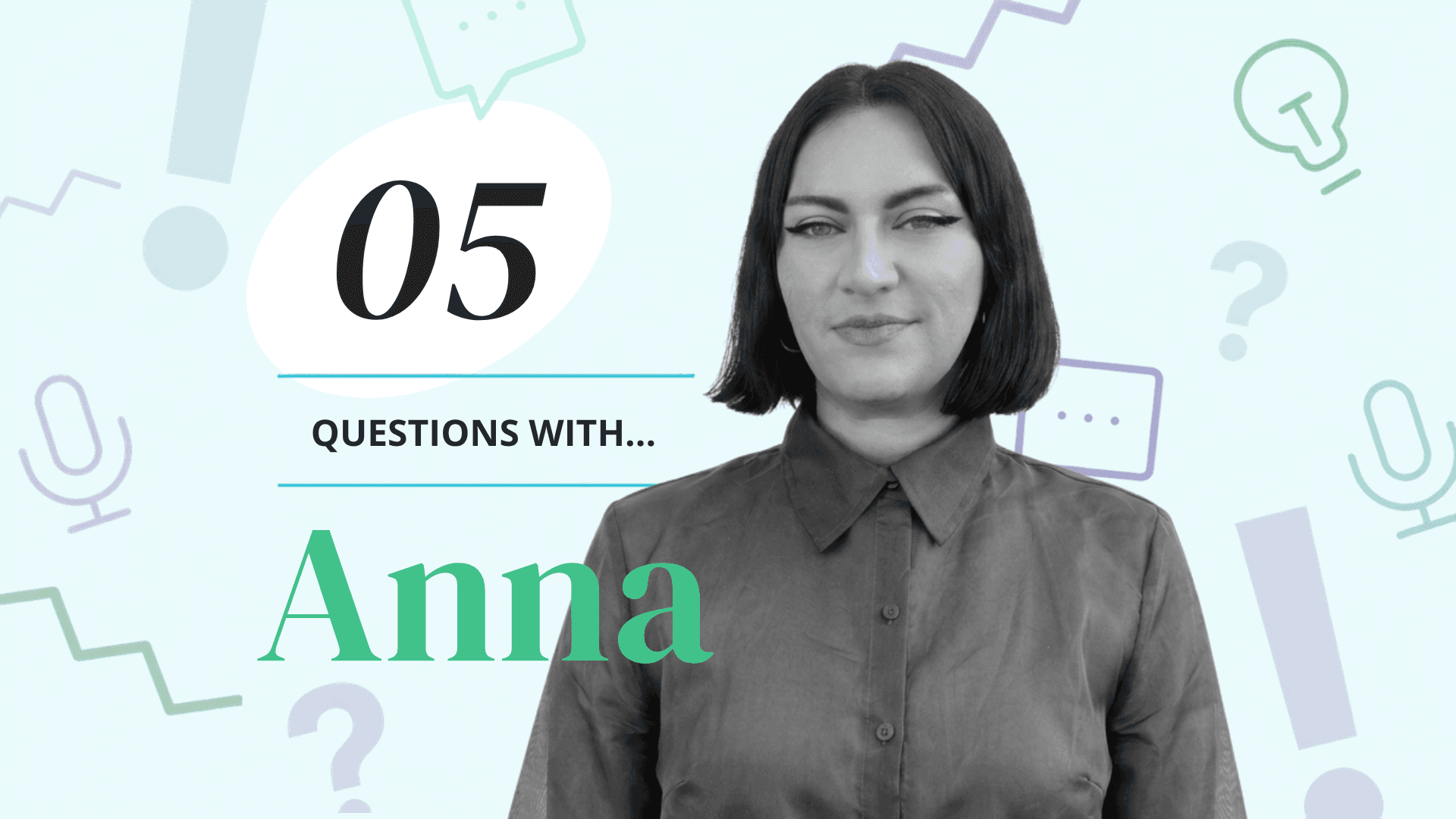
5 Questions With Anna Anderson
0:00
0:00
This is the second entry in our ongoing series called “5 Questions With”, a collection of conversations with members of the HappyFunCorp team about their areas of expertise.
Today, we sat down with Anna Anderson, a product manager at HappyFunCorp, to talk about topics including the evolution of the PM role, healthy team collaboration, evaluating client engagements, prioritizing under pressure, and what genuinely is exciting about where product work is heading.
Dustin Moore: We'll jump right in. How do you see the product manager role evolving over the next few years, especially as AI changes how teams build and ship?
Anna Anderson: That is a great question and one that is top of mind for a lot of us right now. So first I want to clearly communicate that AI is a tool with known costs. Environmental, political, organizational, impersonal. It consumes real energy and resources, and it requires human direction to be used responsibly. It also carries an opportunity cost. Every time we delegate our thinking to a predictive model, we risk weakening human judgment, craft and curiosity. Those are things that no AI model can replicate. I use AI, but I don't treat it as a limitless resource or replacement for human work and creativity. To me, AI exists as a tool to pull more thought out of people. So, my guiding framework for using AI rests on understanding what it fundamentally is a multitude of data sets, massive compute power and language models.
The key to using AI competently is understanding what it is and what it isn't. So, AI excels at what I call, quote, backwards facing tasks such as synthesizing existing research, organizing documentation, and identifying patterns and data. That's all real and significant work in my role. And I do these things every day. And AI can be used effectively for those tasks. But AI doesn't have the ability to, quote, look forward as in create anything new. An important distinction to me is that prediction and creation are fundamentally different cognitive acts. AI does one really well, but the other, I feel, is best handled by humans. Sometimes an output could feel original, but it's really an amalgamation of the creativity of many humans that models have trained off being presented back to us.
When we hand off some of our more monotonous, time consuming tasks to AI, we create space to do work that requires human context, strategy and judgment. And the bar for product thinking goes way up. Speed is only an advantage if you know where you're going. AI can move you faster, but it can't really tell you whether you're headed in the right direction. That being said, I think the PM will do well from here on.
Our PMs who use AI to accelerate the work that can be delegated efficiently and effectively, as in PM's writing technically sound and valuable prompts and getting good results and data. Those PMs were able to lead their teams better, test their assumptions earlier and spend the time they get back with users and clients getting real human feedback or refining strategy and objectives.
Lastly, there's just one more piece I keep going back to. It bears repeating that taste, empathy and curiosity are skills that I believe will become the differentiator in the coming years. Anyone who is able to generate code with AI, but few will be able to discern what is worth making and what will bring clients value long term. I'm a believer in quality and deliberate work. No one wants AI slop in their work or their products and authenticity and human discernment and work shows I think now more than ever.
Dustin Moore: Fantastic. Thank you. Next question. What does great collaboration between product design and engineering actually look like day to day and where does it most often break down?
Anna Anderson: I think this is an area, another area where AI acceleration really exposes the weak points a team has. So, for me, the first step is security and empowerment for each person on my team. I want everyone to feel like we're all on the same side, advocating both for each other and for the product we're building together. I want each team member to feel ownership and pride for the work we're doing together and not just their slice of it as a base. From there, everyone's mental model of the work has to be aligned, so when things get technical, it's easy to wave parts away. That's a dev thing, that's not my problem to understand, etc. The way we work now really doesn't allow for that.
Everybody needs to hold a clear mental model and be able to see and offer feedback across the whole team on it. Kind of embracing some of that friction. And in the process, there are ways to use AI to help with that too. Creating queryable knowledge bases from the product code repositories is a great tool for information sharing and streamlining that I've been using and some of my current projects. Then there's making sure that we're working towards the same set of goals. That sounds super simple, but there are a lot of moving pieces. Different projects need different focuses, and goals are always being iterated, so we have to keep moving in the same direction.
The last layer of success, you know, really now more than ever, is that PMs can use AI to understand levels of technical architecture and code that maybe not every technical PM could reach before. So if I have a question about something, I can tap into GitHub and just educate myself. Think breakdowns in this process come from silence if somebody doesn't raise a technical concern because they assume everyone else has it handled? It seems small at the time, but it quickly snowballs. So, I work to build environments where the team can get into the details and interrogate ideas to build a stronger and smarter product.
Dustin Moore: What signals tell you a client is well positioned to get the most out of the partnership?
Anna Anderson: It depends on who we're working with. But the first thing I look for is one person who's going to be the decider that keeps bureaucracy out of product decisions and lets us move fast. A stakeholder who's engaged and empowered to make these calls is a big green flag. From there, a client who can articulate what success looks like, not just at launch, but if they can tell me what success would look like in three or six months, I know they have a really strong vision that we can help them execute.
Lastly, the biggest tool in collaboration for me is really mutual trust. I love it when a client is flexible in their approach, not necessarily their goal, but how we get there together when we're truly thought partners and creative curiosity goes both ways. Building together and having that trust early on lets us have conversations that lend to everyone's success.
Dustin Moore: That was great. I really like how you think about that. What's your approach to prioritization when a client has more ideas than they might have? Runway.
Anna Anderson: I start by asking whether it's a discovery or a direction challenge. Meaning is the product just bigger than we thought, or have we not really nailed down our goals that we need to ship for mvp? More ideas than Runway is actually a great thing to have. Honestly, it's my job to figure out the sequence for delivery, not necessarily limit client ideas or goals after that. Discovery is really vital for success. All the rich information we gather in discovery sessions can be refined and prioritized with frameworks, but it's also an opportunity to reduce the unknown when there's a technical component with a lot of unknowns. Prototyping is a powerful tool and we can do that quite rapidly. Now with AI, we prototype to validate technical feasibility, and to validate how long a full build of those ideas will take.
From there, we can create a much more accurate plan for actually delivering mvp. One more thing I really want to stress is that prioritization is a continuous practice, not a one-time exercise. The team and I prioritize every day in standups, but I'm also talking to clients about what matters most to them on a regular basis. Every client I work with I meet with a minimum of quarterly and [most] often [more] than that. Those conversations exist to recalibrate what is shifting in their business needs, where priorities need to move, and how our team will be working as a result. Roadmaps are always evolving and especially right now as technology shifts and changes so fast. What was crucial a few months ago is different today based on the technical landscape.
Dustin Moore: I really love the way that you think about a lot of this. It puts it into a perspective and a framework that makes it really accessible. With that in mind, what are you excited about in the product space right now?
Anna Anderson: I think mostly the renewed emphasis on product craft. AI lowers the cost of building and the differentiation between good work and bad work moves back to taste, judgment and user understanding. These core PM skills have been undervalued in the past few years, in my opinion, and I think we'll see a renewed emphasis on them. A faster development cycle thanks to AI also frees up time at both ends of our product lifecycle. At the start, this means digging deeper into requirements and discovery as I touched on before. Understanding user goals and milestones deeply before we begin work is a great privilege, and at the end of the product life cycle it means more tools for testing, gathering consumer feedback, and iterating quickly. That's a real shift from spending most of the engagement grinding through dev and QA and building.
This process shift pulls me more into the actual product work and that's what makes it compelling. I'm also excited about reaching technical areas I couldn't before using AI to build a prototype myself or even a website. Asking technical questions about complex areas in a project's code base and doing that independently from the development team is really exciting. Having so much information accessible to me just supports me in making the best product decisions that I can and freeing up more time for creativity and strategy.
Dustin Moore: If there's one through line in your answers, it's that automation raises the bar rather than lowering it. When the execution layer gets cheap, the human layer becomes a differentiator.
We heard a lot about that today. Taste, empathy, judgment, and the discipline to keep prioritizing every single day are going to be what help set teams apart.
Thanks very much for having this conversation with us, Anna. I really appreciate your time.
Anna Anderson: Thank you.